The Principal Effect: How Investing in School Leaders Is Key to Solving Education’s Challenges

Summary
Policymakers often treat the growing array of school challenges separately, developing different strategies for each; however, this fragmented approach overlooks the central role principals play in influencing all teacher and student outcomes. Research has found that strengthening school leadership is a key strategy for school improvement—one with strong equity implications. Principals affect teacher and student outcomes by (1) supporting effective instruction; (2) retaining teachers, thus strengthening school stability and expertise; and (3) creating a positive climate that welcomes and connects staff, students, and families. Their ability to retain teachers and boost student achievement is influenced by high-quality preservice preparation and in-service professional development focused on supporting instruction, developing staff, meeting the needs of diverse learners, and managing change. Policymakers can strengthen principal effectiveness by investing in high-quality professional learning; building pipelines for recruiting, preparing, and developing principals; improving principals’ working and learning conditions; ensuring adequate compensation; and creating productive evaluation and mentoring systems.
The report on which this brief is based can be found here.
Introduction
Since the pandemic, public schools have faced a growing set of challenges, including mounting concerns about students’ mental health, chronic absenteeism, learning loss, high teacher attrition rates, and teacher shortages. Often policymakers treat these challenges separately, trying to develop different strategies to address each one. This fragmented approach, however, overlooks the one factor that influences all of them: the school principal.
In their pioneering research review of school leadership, Kenneth Leithwood and his coauthors noted that “leadership is second only to classroom instruction among all school-related factors that contribute to what students learn at school.” A more recent research review by Jason Grissom and colleagues noted that school leadership is, in many ways, the central school-level factor, since they create conditions for teacher effectiveness as well as for schoolwide improvements, noting:
It is difficult to envision an investment with a higher ceiling on its potential return than a successful effort to improve principal leadership.
By virtue of their role, principals influence the experiences of every person in the school and thus play a key role in improving student and teacher outcomes. Strengthening and investing in school leadership is also an equity strategy, given that effective principals have even larger effects in schools serving students from historically underserved communities.
This brief draws on a report summarizing the large body of research about principals’ effects and about the kind of learning opportunities that enable them to become more effective. It demonstrates the importance of investing in school leadership and leveraging their capacity for mitigating the challenges currently facing schools. In addition, it offers evidence-based policy recommendations for how to enhance principal effectiveness.
How Principals Improve Education Outcomes
A growing number of rigorous studies provide convincing evidence that some principals are more effective than others at promoting student attendance and achievement in English language arts and mathematics, and that these principals are more highly rated by both supervisors and teachers.
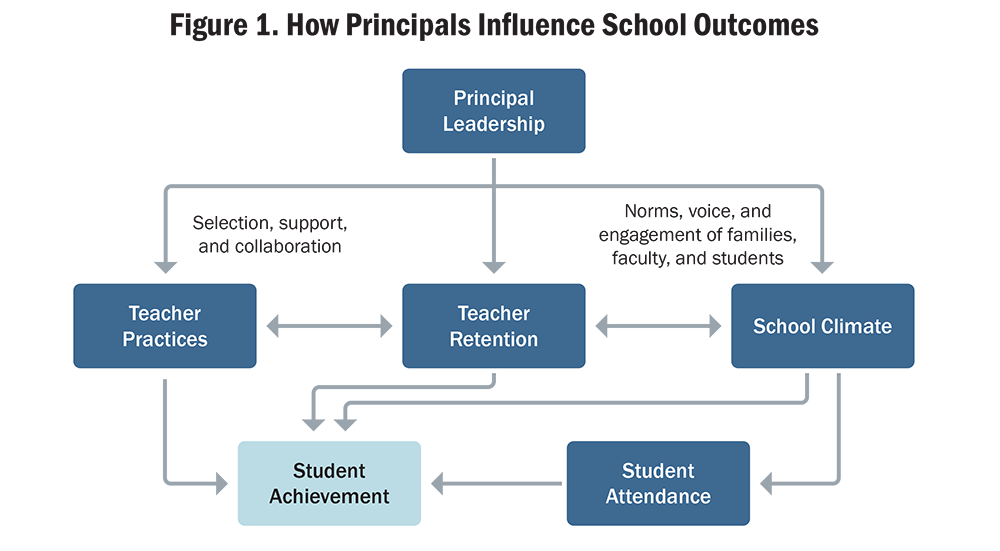
Researchers agree that principals’ effects on student academic outcomes come about, for the most part, through their support for teachers and their practices. This occurs as principals orchestrate teacher professional development, productive teacher assignments, opportunities for teacher collaboration, professional culture, improvement-focused feedback, and the working conditions that teachers experience within a school. Actions that help teachers improve instruction within and across classrooms increase their experience of collegiality, their ability to engage in collective problem-solving, and their sense of efficacy, all of which matter for both student achievement and teacher retention.
In addition, principals play a large role in supporting a positive school climate, which strongly influences students’ attendance, sense of self-efficacy, and achievement. These factors and other actions of the principal also play a large role in determining whether teachers stay in the school, which in turn matters for student achievement. (See Figure 1.)
These factors are interrelated: A positive school climate boosts student attendance, which supports achievement, while also encouraging teachers to stay in the school, which supports staff stability and student achievement. Studies have uncovered at least three key mechanisms by which principals affect student outcomes:
- Supporting effective instruction
- Retaining teachers, thereby strengthening school stability and expertise
- Creating a positive climate that welcomes and connects staff, students, and families
Effective principals support strong instruction, which improves student learning. A large body of research has identified strong links between principals’ instructional leadership practices and improved student outcomes. Principals play a major role in supporting strong instruction and, consequently, student learning, by:
- engaging with teachers around instruction: enabling successful practices, observing, coaching, providing feedback, and reviewing data together;
- working with staff to develop a cohesive educational program with strong curriculum and shared practices;
- investing in high-quality staff development;
- enabling teacher collaboration for planning and professional learning; and
- developing shared instructional leadership and shared decision-making.
For example, a study of Chicago principals in strongly improving schools contrasted with those in schools that were stagnant in achievement found that principals in improving schools built a “culture of shared organizational learning.” The goals that guided organizational learning were linked to the school vision, which helped teachers “understand how their collective efforts [within the school] contribute to the larger purpose.” Leaders of improving schools also set aside time for staff to regularly work together in a focused, productive manner and more frequently shared leadership across their staff than did their colleagues in schools with stagnant scores.
Effective principals retain teachers, which improves school stability and student outcomes. Just as support of collaboration and orchestration of a shared vision increases school effectiveness, these aspects of leadership are related to teacher retention, which in turn further supports school stability and student achievement. The ability of effective principals to retain teachers is a function of their ability to both create a strong sense of shared mission and to support the work of teachers individually and collectively.
For example, the most important factors identified in a survey of more than 2,000 current and former California teachers about why they chose to stay in the profession were the quality of relationships among the staff and the opportunity to participate in school decision-making. Similarly, a survey of urban teachers in a Midwest city found that collaboration with fellow teachers positively affected their decisions to remain teaching at their school. As a teacher in the study explained:
[We are] a shared learning community. We are very involved with each other in planning, learning … lots of team preparation. We all hold the same vision. We believe in our mission and work together to achieve that.
Teachers who rate their principals as effective and supportive are significantly less likely to leave their schools, and this impact is largest in high-need schools. Therefore, building leadership capacity can be a high-leverage strategy for achieving greater equity across schools. Specific principal actions that are positively related to teacher retention include:
- developing a safe, nurturing environment that supports well-being and fosters belonging of students and staff;
- supporting teachers at all experience levels with resources and caring;
- buffering teachers from external demands while protecting their time and agency; and
- fostering teacher collaboration and involvement in decision-making.
Effective principals create a positive climate, which improves student belonging, attendance, and achievement, as well as teacher retention. As leaders of schools, principals play a key role in shaping the school climate, which shapes the ways in which adults and students interact with one another. A positive school climate promotes student and teacher well-being, cultivates a sense of belonging, and supports strong relationships among adults and children. Because children learn best when they feel safe and supported, and their learning is impaired when they are fearful or traumatized, they benefit from supportive, trust-filled environments that enable them to manage stress. A substantial body of research shows that a positive school climate in which students feel a strong sense of belonging and support improves student attendance, behaviors, graduation rates, and academic achievement. Furthermore, positive school climates reduce the negative effects of poverty on achievement—effectively boosting grades, test scores, and student engagement.
Creating such an environment involves structuring supports for both teachers and students, as well as reaching out to families, as students’ willingness to attend school is related not only to their relationships with teachers, but also to the involvement of their parents. Principals enable a positive school climate by:
- adopting policies and practices that undergird positive teacher–student relationships characterized by warmth, acceptance, and support;
- building a welcoming, inclusive, communicative school culture that builds trust between students, teachers, and families;
- creating structures and expectations for engaging families regularly;
- establishing high expectations for student learning for both teachers and students; and
- employing democratic school principles such as shared decision-making.
Thus, investments in principals’ knowledge, skills, and capacity must be part of any improvement strategy, particularly in schools facing the largest challenges.
The Importance of Supporting and Retaining Principals
Principal retention is important for both teacher stability and student achievement. In general, more experienced principals are more effective. Furthermore, principal turnover is associated with both teacher turnover and declines in student test scores, as well as drops in ratings of school climate. These effects are larger in high-poverty schools and when the incoming principal is both external and inexperienced.
Principal turnover is typically higher in schools with fewer resources, less qualified teachers, and less central office support; these are often schools that serve concentrations of students from economically disadvantaged backgrounds. Principals are also more likely to turn over when they have fewer learning opportunities, including lower-quality principal preparation and fewer opportunities for coaching and networking.
Better-prepared principals are both more effective and more likely to stay in the profession, creating a virtuous circle in support of student learning. In preparation and professional development, important content includes learning how to lead and support instruction, improve school climate and conditions, develop staff, and meet diverse students’ needs in ways that are culturally responsive and that attend to the whole child. Effective methods of learning build on candidates’ experiences and current needs, allowing candidates to apply knowledge in practice through case studies, real-world projects that address problems of practice, and mentoring from expert veterans as part of a preservice internship or in-service coaching. Opportunities to problem-solve with other principals as part of a cohort or network are also important.
Studies have found that principals’ past learning opportunities—including high-quality preparation that includes strong internships and readily available high-quality professional development—are associated with how well they retain teachers and support student achievement growth in both English language arts and mathematics.
In a California study, Black, Latinx, and Pacific Islander students experienced the largest gains, especially if their principal had substantial access to professional development focused on instructional leadership. The differentials in mathematics learning for these historically underserved students who had a principal with little versus extensive training in this area, for example, were equivalent to approximately 4 months of instruction.
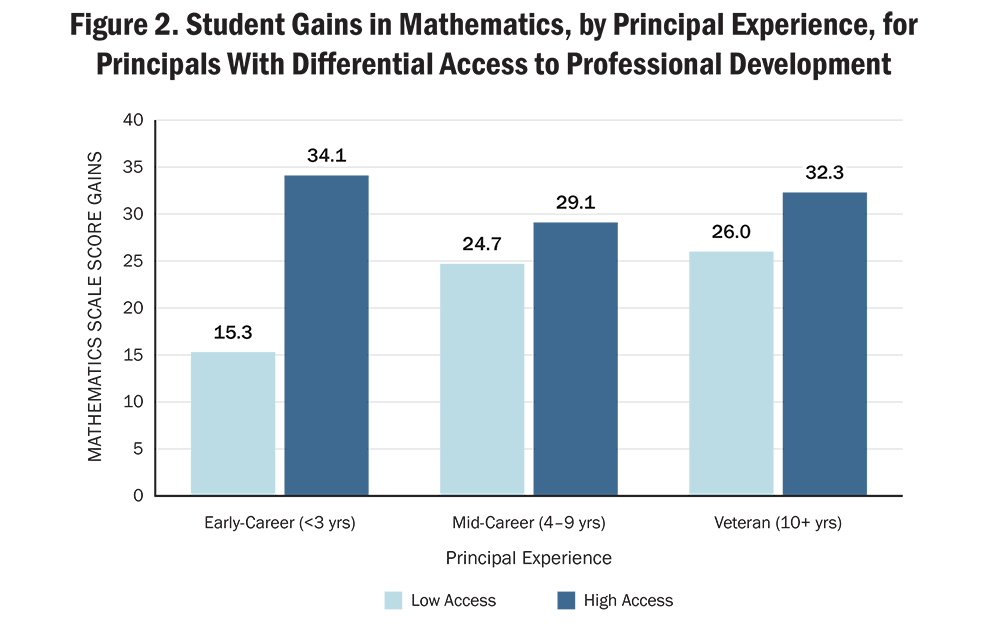
In addition, students in schools led by early-career principals who experienced extensive professional development—including on instructional leadership, teaching diverse learners, and managing change—demonstrated achievement gains in mathematics greater than those in schools led by more senior principals with similar access to professional development. (See Figure 2.) While principal experience generally correlates with higher student achievement growth, these results also show that access to intensive professional development can help close the gap in learning for both new principals and their students.
Professional development programs that serve cohorts of principals with instruction, networking, and mentoring or coaching have been found to be associated with growth in principal effectiveness, as measured by gains in student achievement. Having high-quality mentoring or coaching as part of these programs has been found to be particularly important for developing principals’ instructional leadership in ways that result in student learning gains. Taken together, all of these studies underscore that principal effectiveness and stability are products not just of individual skill, but of systemic supports and policy designs.